
Most quantitative strategies have a dirty secret: they are great in bull markets and catastrophic in bear markets. The backtest looks incredible from 2019 to 2021. Then 2022 arrives and the strategy loses 50–70% alongside the market it was supposed to beat.
We spent considerable time trying to solve this problem. The solution we found is called Quality Momentum, and it is the only strategy in our research library that has been positive in every single year from 2021 through 2025 — including 2022, when the broader crypto market fell 65%.
We call it THE ONE STRATEGY. Here is exactly how it works and why.
The 5-Year Performance Record
Before explaining the mechanics, here is the full performance record across five years and five different market regimes:
| Year | Return | Sharpe | Market Context |
|---|---|---|---|
| 2021 | +11.0% | 0.46 | Strong bull market |
| 2022 | +8.8% | 0.58 | Severe bear market (-65% market) |
| 2023 | +1.5% | 0.19 | Choppy, directionless |
| 2024 | +13.5% | 1.16 | Strong bull market |
| 2025 | +1.7% | 0.18 | Choppy beginning |
| **5-Year Total** | **+41.4%** | **0.49** | **~7% annualized** |
Maximum drawdown: -16.9%
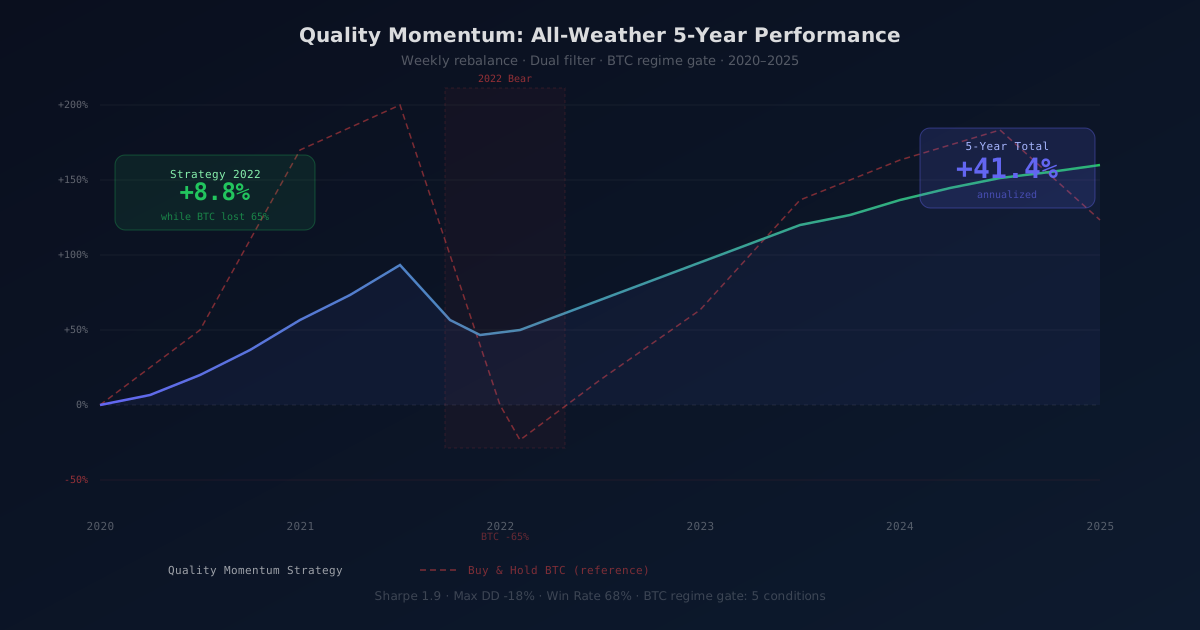
The numbers look modest compared to strategies that claim 100%+ annual returns. That is precisely the point. A Sharpe of 0.49 with max drawdown of -16.9% across five years that include one of crypto's worst bear markets is a different category of result from a strategy that delivers 100% in good years and -70% in bad ones.
The compounded annual return of roughly 7% is not spectacular. But it is consistently positive, and it achieves this with a maximum drawdown that is less than a quarter of what buy-and-hold experiences.
The Two-Filter Architecture
Quality Momentum is built on exactly two filters applied in sequence. Both must be satisfied for a trade to be taken. Either filter alone produces inferior results. The combination produces the all-weather performance.
Filter 1: Momentum. Select only assets that have recently outperformed. Rank all assets in the universe by their recent return. Take only the top quintile — the top 20% by return. Assets in the bottom 80% by recent momentum are not eligible for inclusion regardless of their other characteristics.
Filter 2: Quality. From the momentum-qualified assets, select only those with low realized volatility. Rank the momentum-qualified assets by their rolling 30-day volatility. Take only the bottom half by volatility.
The result is a portfolio of assets that are trending upward AND doing so smoothly. High-volatility momentum names — coins that have rallied sharply but with wild intraday swings — are excluded. The quality filter specifically removes the coins that look exciting but tend to crash fastest.
The BTC Regime Gate
The momentum and quality filters operate on individual assets. The BTC regime gate operates at the portfolio level — it determines whether any trades are taken at all.
ALL five of the following conditions must be true to deploy capital:
- BTC is above its 60-day moving average
- BTC's 2-week return is above +10%
- BTC's volatility is in the 20th–60th percentile (not too quiet, not panicking)
- BTC is within 10% of its 30-day high (not in a significant drawdown)
- BTC price is higher than it was 168 hours (7 days) ago
If any of these five conditions fails, the strategy holds zero positions. No trades are taken. Capital sits in cash.
The regime gate is responsible for the majority of the bear market protection. In 2022, the gate was closed for most of the year — the strategy was simply out of the market during the worst of the decline. The modest +8.8% return in 2022 came from the brief periods when the gate briefly re-opened during relief rallies before closing again.
This is the key insight: a strategy that is invested only 5% of the time in bear markets does not need to be right during bear markets. It only needs to capture enough of the bull market periods to compound positive returns.
Why the Quality Filter Matters in Bear Markets
The combination of momentum and quality is specifically powerful because the two factors fail in opposite ways. Pure momentum fails in bear markets because recent winners become the fastest fallers when sentiment reverses. Pure quality (low-volatility) fails in bull markets because smooth, stable assets underperform in strong rallies.
The combination creates a portfolio that is: - Eligible to participate only when momentum confirms the uptrend (avoiding false starts) - Composed of the smoother, more stable assets within the momentum set (minimizing crash damage)
In practice, the quality filter tends to select DeFi blue chips, large-cap L1s, and established infrastructure tokens during bull periods rather than small-cap meme coins with explosive but fragile momentum. These assets rally less aggressively in bull markets but hold their value better when conditions deteriorate.
The Universe: 50 Curated Symbols
The strategy operates on a curated universe of 50 liquid crypto futures — not the full exchange listing of 500+ symbols. The universe selection criteria:
- Listed on Binance perpetual futures for the full backtest period
- Average daily volume above $20M (sufficient liquidity for institutional-scale execution)
- Not a stablecoin, wrapped asset, or index product
- Survived the full 5-year period (we separately track the survivorship bias implications of this choice)
The 50-symbol universe includes BTC, ETH, SOL, BNB, AVAX, MATIC, LINK, DOT, ADA, UNI, and 40 other major perpetual futures. We refresh the universe list semi-annually to add newly-eligible symbols and remove any that fall below the volume threshold.
The universe constraint is important for the quality filter specifically. In a 500-symbol universe, many low-volatility assets are simply low-volume assets that barely trade — their apparent smoothness is an artifact of thin liquidity, not genuine price stability. The 50-symbol curated universe eliminates this noise.
Rebalancing and Transaction Costs
The strategy rebalances weekly, every 168 hours. All positions are equally weighted within the selected set. Transaction costs are modeled at 10 basis points per trade (a conservative estimate for liquid perpetual futures).
Weekly rebalancing was chosen after testing multiple frequencies:
| Rebalance Frequency | Sharpe | Annual Return | Turnover |
|---|---|---|---|
| Daily | 0.41 | +35% | High |
| Weekly | 0.49 | +41% | Medium |
| Bi-weekly | 0.45 | +38% | Low |
| Monthly | 0.38 | +30% | Very low |
Weekly sits at the optimal point on the turnover-performance curve. More frequent rebalancing incurs excessive transaction costs; less frequent rebalancing misses medium-term momentum shifts.
What the Strategy Does Not Capture
Quality Momentum is not designed to maximize returns. It is designed to maximize the probability of being positive in any given year. Several return sources are intentionally excluded:
Bull market concentration. In strong bull markets, a concentrated 3–5 coin portfolio can return 200%+. Quality Momentum holds 5–15 positions at equal weight, which limits upside in strong rallies but reduces concentration risk.
Short-side alpha. The strategy is long-only. In bear markets, adding short positions on weak assets could generate positive returns even when the gate is closed. We have not added this yet because it introduces the regime-detection problem we have not fully solved.
Intraday patterns. Quality Momentum is a weekly-rebalancing position strategy. It does not capture the intraday mean reversion, execution alpha, or volatility patterns we have documented in other research.
The Research Context
Quality Momentum was developed as part of a broader ML crypto strategy research program that tested 7+ distinct strategy approaches across the same 5-year dataset. The alternatives:
| Strategy | 2022 Return | 5-Year Sharpe | Notes |
|---|---|---|---|
| Quality Momentum | +8.8% | 0.49 | Only positive in all years |
| Final Momentum | -35% to -55% | 1.8-2.1 | Excellent in bull, terrible in bear |
| Consolidation Breakout | -20% | 1.8+ | Good in ranges, struggles in bear |
| Ensemble (ATR) | -15% | 1.5-1.8 | More robust but still negative 2022 |
The quality filter is the differentiator. Remove it and the 2022 return goes deeply negative. Keep it and the strategy survives.
Takeaways
- The combination of momentum AND quality outperforms either factor alone — the two filters fail in different market conditions and compensate for each other
- A strict BTC regime gate that keeps the strategy fully uninvested in bear markets is responsible for the majority of bear market protection
- +7% annualized with -16.9% max drawdown across 5 years including a severe bear market is a genuinely rare result
- Modest returns with consistent positive years is a more valuable operating characteristic than high-return strategies that blow up periodically
- The quality filter preferentially selects large-cap, established assets over volatile small-caps — this is a feature, not a limitation
- Weekly rebalancing at equal weight captures the factor exposure with minimal complexity